
Woody > Symphoricarpos > Symphoricarpos x doorenbosii > Symphoricarpos x doorenbosii
Symphoricarpos x doorenbosii
Coral Berry
| Family |
| Caprifoliaceae |
| Genus |
| Symphoricarpos |
| Species |
| x doorenbosii |
| Category |
| Woody |
| Type |
| Shrub (deciduous) |
| USDA Hardiness Zone |
| 3 - 7 |
| Canadian Hardiness Zone |
| 3a - 7b |
| RHS Hardiness Zone |
| H7 |
| Temperature (°C) |
| -20 |
| Temperature (°F) |
| -4 |
| Height |
| 90 - 150 cm |
| Spread |
| 90 - 150 cm |
Photographs
Cultivars
click to expand
Description and Growing Information
Flowering Period









| General Description |
| Original hybrid tends to be leggier than more recent cultivars. An interspecies hybrid developed in Holland by horticulturist G. A. Doorenbos. |
| Landscape |
| Not as widely used in landscapes as some of the newer cultivars. Can be used in informal hedges, borders and ground-cover. Its dense suckering root system can help hold together sloping ground that may tend toward erosion. |
| Cultivation |
| Can be grown in full sun to part shade. Adapts easily to many soil types. It prefers Symphoricarpus’ native limestone, clay and ideally moist well-drained conditions. |
| Shape |
| A small to medium sized deciduous shrub. Tends to be rangy, with extended bowing branches. Cultivars of this hybrid have been bred to be rounder and more compact. |
| Growth |
| Fast |
| Pests |
| Powdery mildew, scale, anthracnose, ruts and berry rot. Resistant to deer as they dislike the berries’ bitter taste. |
| Habitat |
| Horticultural origin. |
| Bark/Stem Description |
| Young bark begins to shred as the shrub ages, giving it an exfoliating appearance. |
| Flower/Leaf Bud Description |
| Buds are petite with a profusion of protective bud scales. |
| Leaf Description |
| Small lamina reach a maximum size of about 4 cm in length and 2.5 cm in width with a rounded tip and cuneate base. Petioles are around 2 mm and are covered in short hairs. 3 - 5 pairs of veins can be observed. |
| Flower Description |
| Flowers appear in clusters and are 2 - 3 mm in length. 4 - 5 petals on each bloom, each attached to a central stem by a short stalk. Flowers on new growth. |
| Fruit Description |
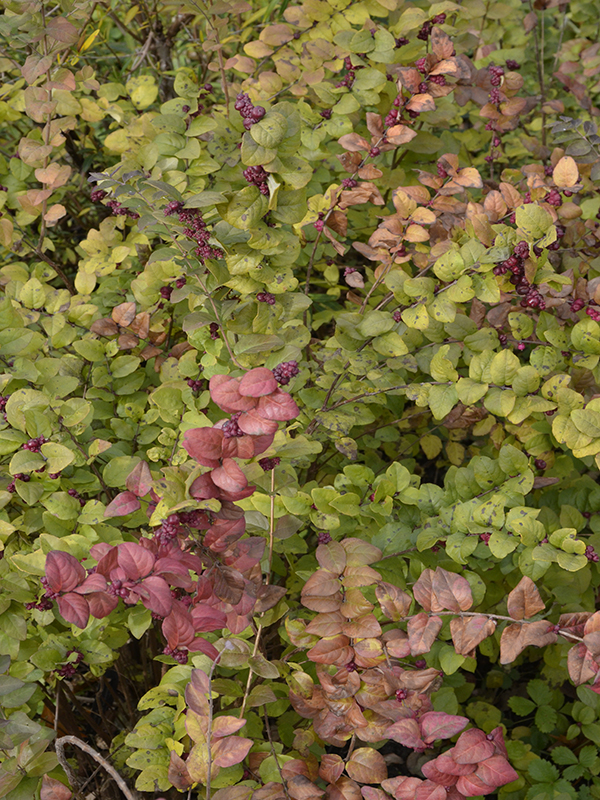
| Berries appear in compact bunches of 5 - 15 mm in size and vary in colour from pale whitish-pink to hot pink. |
| Colour Description |
| The berries vary from pale whitish-pink to hot pink. The flowers can be white or pink. The leaves are a dark green to greenish-blue on the upper surface and have a slightly tomentose underside. The bark is a dark brown colour that tends to fade to grey as it ages. |
| Texture Description |
| Medium. |
| Propagation |
| Can be propagated by dividing basal shoots and transplanting. Semi-hardwood cuttings in autumn or softwood cuttings in summer. Semi-hardwood cuttings should be rooted in perlite only and softwood cuttings should be rooted in a mix of perlite and peat. Can also be propagated by seed. However, its seeds have a hard outer coating that makes it challenging to germinate without stratifying them by soaking in water- first at room temperature for 60 days, then at 5°C for 180 days. |
| Ethnobotanical Uses (Disclaimer) |
| Fruit is edible but bitter and unpalatable and ingesting large quantities may cause nausea and/or diarrhea. |

top