Tropicals, Woody > Bougainvillea > Bougainvillea spectabilis > Bougainvillea spectabilis
Bougainvillea spectabilis
Great Bougainvillea
Origin: Brazil, Bolivia, Peru, and Argentina .
| Family |
| Nyctaginaceae |
| Genus |
| Bougainvillea |
| Species |
| spectabilis |
| Category |
| Tropicals, Woody |
| Type |
| Shrub (evergreen), Vine |
| USDA Hardiness Zone |
| 10 - 11 |
| Canadian Hardiness Zone |
| Requires cold season protection under glass. |
| RHS Hardiness Zone |
| H1c - H3 |
| Temperature (°C) |
| -5 - 10 |
| Temperature (°F) |
| 23 - 50 |
| Spread |
| 4.6 - 12.2 m |
Photographs
Cultivars
click to expand
Description and Growing Information
Flowering Period








| Landscape |
| Normally grown as an ornamental plant. |
| Cultivation |
| Best grown in full sun with dry conditions and fertile soil. |
| Leaf Description |
| Heart-shaped. |
| Flower Description |
| Small and inconspicuous, highlighted by several brightly coloured bracts. |
| Fruit Description |
| Small and inconspicuous, dry, with elongated achene. |
| Colour Description |
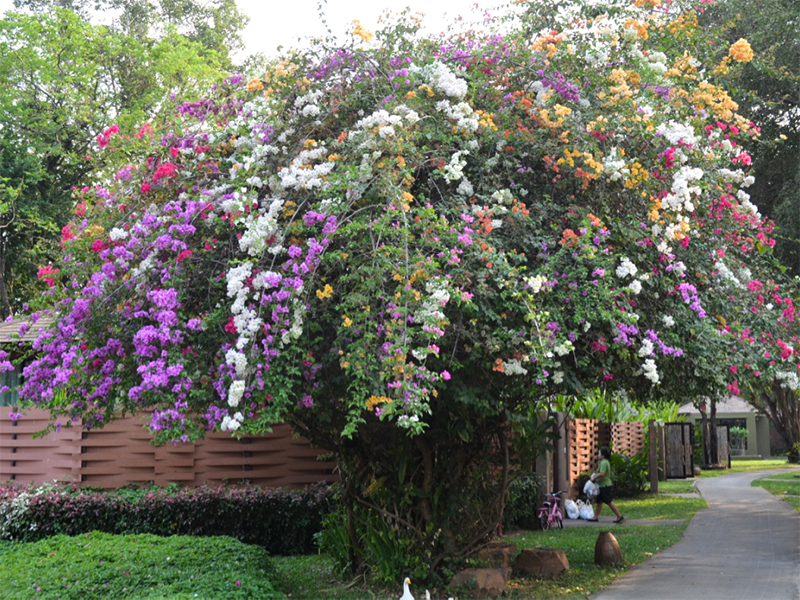
| Flowers are white. Bracts range from white, red, mauve, purple-red, or orange. Foliage is yellow-green to medium green. |
| Texture Description |
| Stems are thorny. |
| Notable Specimens |
| Wishing Tree Resort, Tha Phrae, Thailand. |
| Propagation |
| By stem and root cuttings. |
| Ethnobotanical Uses (Disclaimer) |
| It has been reported to have anti-inflammatory, anti-bacterial, anti-viral, anti-tumor, anti-hypercholestrolemic, anti-hyperlipidemic, and anti-fertility properties. The Yanadi tribe of Chittoor district, Andhra Pradesh, India, once used the leaves to heal diabetes. |

top